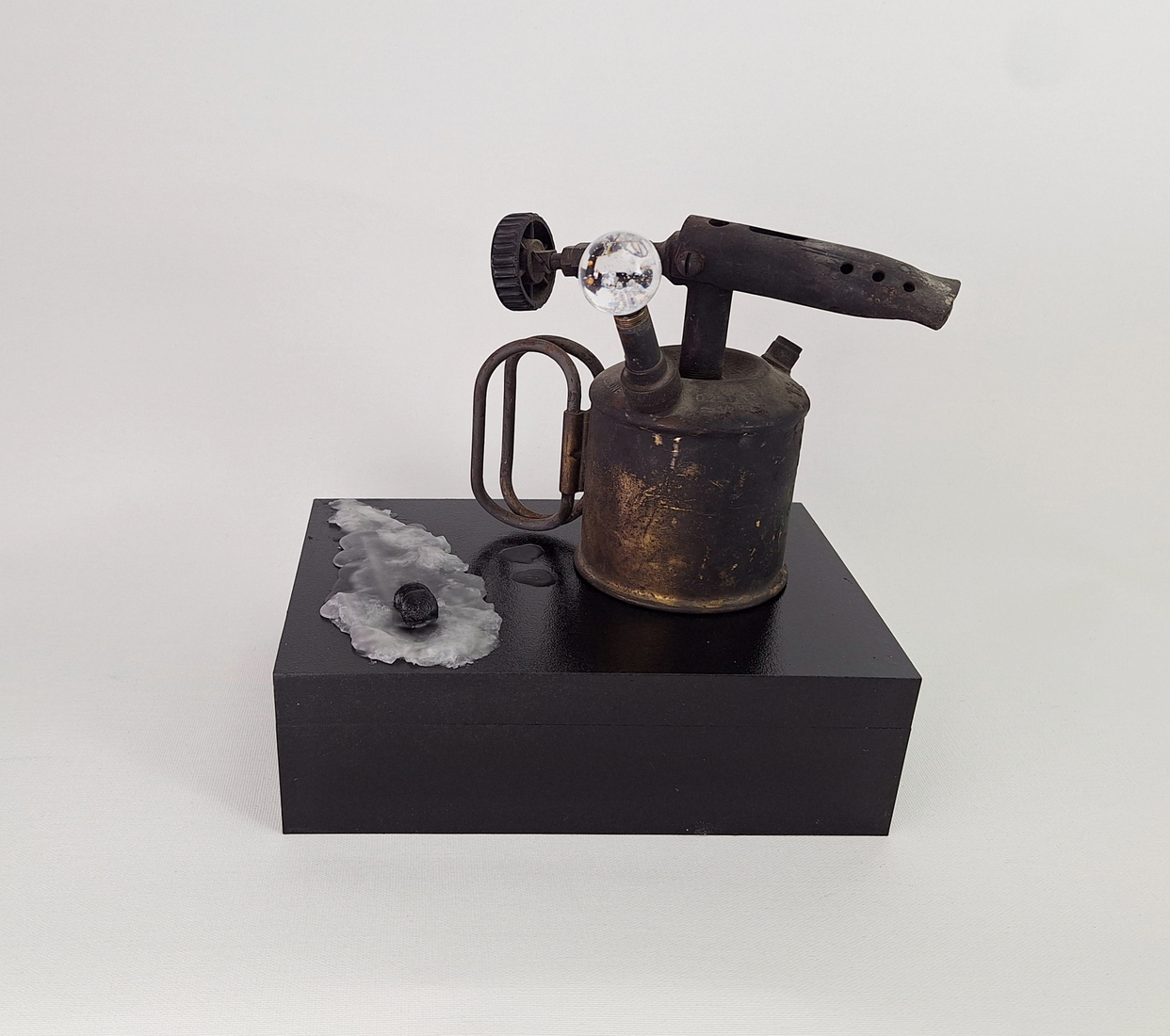
Terminal Phase consists of an aged petrol burner placed on a dark industrial plinth. Part of the burner’s pumping mechanism has been removed from the device and is partially submerged into a localized field of white wax on the surface of the plinth. The burner itself remains physically intact but has become functionally compromised. Attached to the burner is a small transparent resin bulb that appears as an anomalous extension or output of the apparatus.
The removed mechanism slowly disappears into the wax, creating uncertainty about the material state of the system. It is unclear whether the component is sinking, melting, being absorbed, fossilized, or emerging. The work stages a transformation process without revealing its cause or temporal origin.
The dark plinth no longer functions merely as support, but as an active material surface that appears to absorb and destabilize the mechanism. The localized wax field suggests a slow and irreversible process of phase transition occurring within the system itself.
The sculpture explores themes of failed functionality, latent transformation, causality and material instability. Rather than illustrating an event, the work presents a condition in which industrial matter appears to lose ontological certainty.